Punching and Laser Cutting
Whether you need complex cut-outs, recurring hole patterns or free-form contours, apra combines punching and laser cutting to meet the requirements of your enclosure project. We also take subsequent folding operations, joining points and assembly steps into account from the outset.
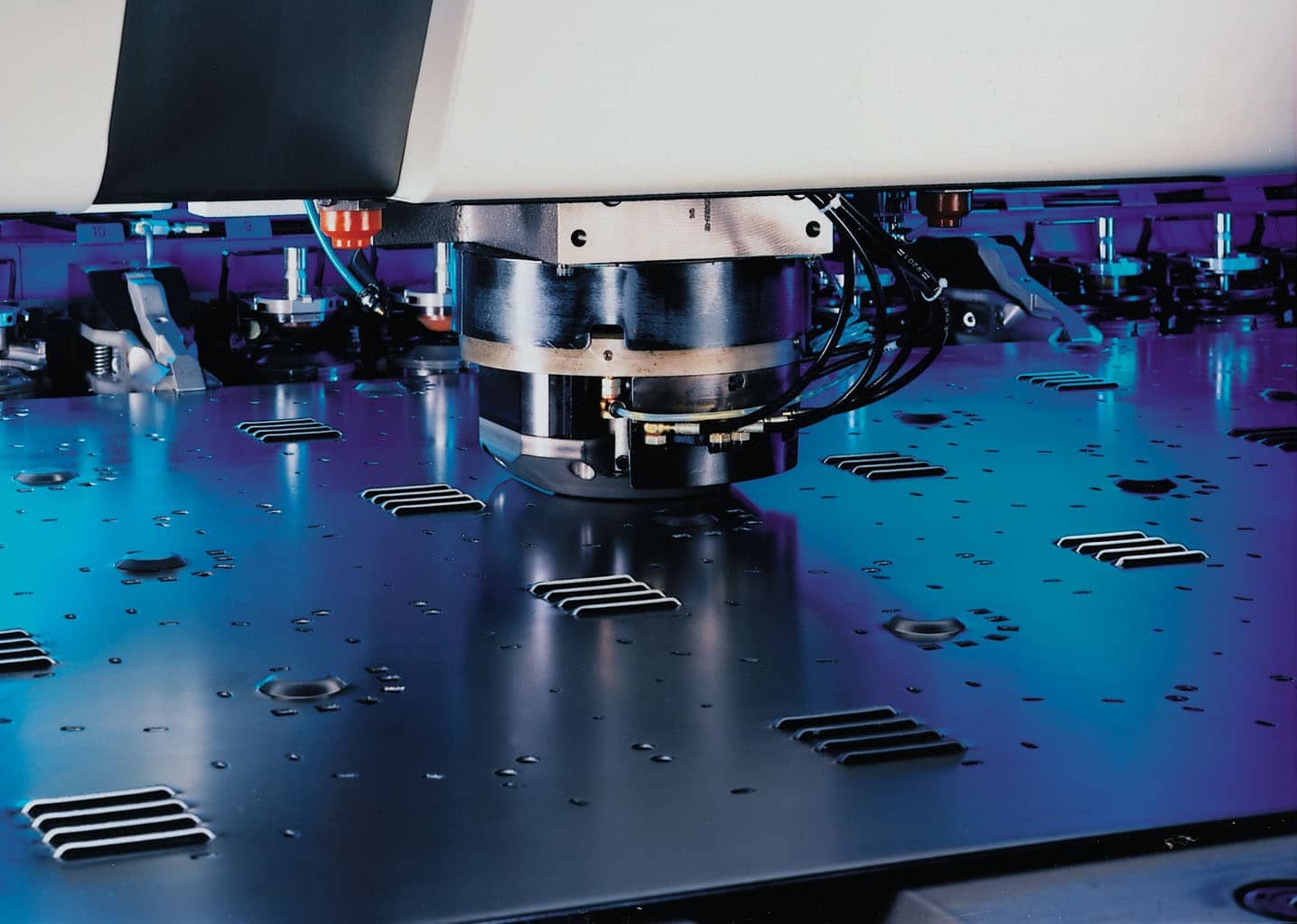
Flexible Sheet Metal Processing for Contours, Cut-outs and Functional Features
The apra Group uses punching and laser cutting to manufacture precise contours, cut-outs and hole patterns for customised enclosures, racks and metal assemblies. Both processes can be selectively combined within a single component and supplemented with embossing, minor forming operations or marking.
The Right Process for Every Geometry
Whether you need a recurring hole pattern, a complex connector cut-out or a free-form outer contour, the geometry, material, sheet thickness and required production volume determine which process is technically and commercially suitable. For components manufactured using combined punching and laser cutting, different features can be produced using the most appropriate process.
| Requirement | Possible Solutions at apra |
|---|---|
|
Repeated cut-outs and hole patterns
|
Punching with suitable tools, for example for rows of holes, circular hole patterns and perforated panels
|
|
Larger or unusual cut-outs
|
Nibbling using several successive punching strokes when no suitable single-stroke tool is available
|
|
Free-form and complex contours
|
Laser cutting without contour-specific punching tools
|
|
Standard holes and free-form contours in one component
|
Combined punching and laser cutting
|
|
Ventilation and functional features
|
Hole patterns, slots, louvres and other project-specific designs
|
|
Recesses and raised features
|
Embossing and forming, for example raised dots, beads, extrusions and countersinks
|
|
Component marking
|
Embossing, dot-peen marking or laser marking, depending on the material and requirements
|
Integrating Functional Features Directly into Sheet Metal Components
Suitable tools allow additional functions to be incorporated directly into flat sheet metal during processing. Depending on component geometry, material and sheet thickness, the following features can be produced:
- Raised dots, beads and snap-fit embossing
- Extrusions, countersinks and recesses
- Louvres and other ventilation features
- Guide elements and selected tabs
- Embossed symbols as well as dot-peen or laser markings
- Pre-punched knock-out openings with break-off tabs
In certain cases, smaller local bends can also be created directly during the punching and laser cutting process. More extensive or larger bending geometries are produced using separate folding and bending processes.
From Project Requirements to a Manufacturing-Ready Solution
You do not need to specify the appropriate manufacturing process when submitting an enquiry. Based on the component’s function, geometry, material, production volume, tolerances, surface requirements and planned subsequent processes, apra assesses which processing method is technically suitable and commercially viable. We then prepare a solution and quotation tailored to your project.
Once the order has been placed, our in-house design and engineering team takes care of the manufacturing-ready implementation and coordinates the technical details with you.

Product- / Project Management
What Is Required for Manufacturing
The key information needed to select the appropriate process includes component geometry, material, sheet thickness, production volume, tolerances, visible surfaces and the required subsequent processing. Laser-cut contours must be defined in the manufacturing data as closed, unambiguous and non-overlapping shapes. Specific requirements for technical drawings and CAD data are agreed individually for each project. Our in-house design and engineering team then prepares the manufacturing-ready design.
Further Processing Through to the Finished Enclosure
Following punching and laser cutting, sheet metal components can undergo further processing, including deburring, straightening, folding, joining and welding. Depending on project requirements, surface treatment, printing, sealing and assembly can also be incorporated into the subsequent manufacturing stages. This transforms individual sheet metal blanks into precision-made enclosure components, front panels, doors, covers, mounting plates or complete assemblies.